
Kitchen
Home Bakery Equipment Checklist: What to Buy First
Plan your first home bakery orders with an equipment checklist, tools you can reuse, dated India prices and a batch-capacity worksheet.
Use this home bakery equipment checklist after choosing the first one or two products you want to sell. Brownie boxes, cupcakes and decorated cakes need different tools. Buying for all three at once can leave you with equipment you rarely use.
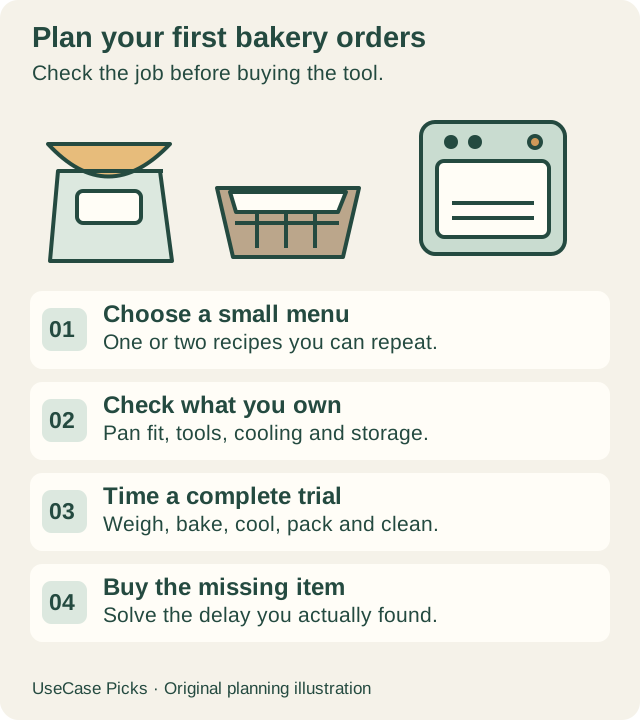
Start with a recipe you have already made successfully. Check what you own, run a complete batch through baking, cooling and packing, then buy the items you are missing.
Start here: check the essentials, check oven and pan fit, or see the dated India prices. Use the free planning worksheet to make your own shopping list.
Sources and India listings were checked on 31 October 2026. This is a researched planning guide. We have not tested the named products, their accuracy or their baking performance. There are no affiliate links.
Choose a Small Menu Before Buying Tools
Choose a product, a pack size and a quantity for one collection slot. For example: six brownie boxes with six pieces in each box. That gives you something specific to practise and cost.
| First menu | Equipment to check first | Purchases that may wait |
|---|---|---|
| Brownies or tray bakes | Recipe-sized pan, cooling space, cutting tool and boxes that fit the portions | Turntable, large piping set, mixer if the recipe uses hand mixing |
| Cookies | Suitable baking tray, portioning method and space for trays to cool between runs | Large cutter collection, many tray sizes, extra oven before a capacity test |
| Cupcakes or simple cakes | Recipe-sized tins, suitable mixing method, cooling rack and carriers | Elaborate decoration tools unless included in the menu |
| Decorated or chilled cakes | Required decorating tools and a workable chilled-storage/transport arrangement | Extra designs and larger orders until the full process is tested |
Use recipes suited to your equipment. A small menu makes it easier to see whether weighing, mixing, baking, cooling or packing is slowing you down.
Home Bakery Equipment Checklist for First Orders
Mark each item Have, Need, or Later. These are starting quantities for a small trial, rather than a requirement to buy a set.
| Job | Start with | What to check |
|---|---|---|
| Weigh ingredients | One digital kitchen scale with grams and tare | Display stays visible under your bowl; bowl plus ingredients fit its capacity; resolution suits the recipe |
| Measure small quantities | Measuring spoons; cups/jug where the recipe calls for them | Readable markings and the same units as the recipe |
| Mix and scrape | Two food-use bowls, a spatula and whisk/spoon | Enough room to mix; tools suit the recipe and can be cleaned properly |
| Bake | A suitable oven and the recipe-sized pan/tray | Baking mode, pan fit, permitted cookware and installation instructions |
| Handle hot equipment | Suitable dry oven gloves and a heat-safe resting area | Safe handling of the actual loaded pan |
| Cool | A suitable rack and clean protected workspace | Room for the whole batch without stacking products too early |
| Store | Suitable labelled food containers and any required refrigerated space | Storage needs of each ingredient, filling and finished product |
| Pack | Food-contact packaging, supports and a closure/label method | Product fits after cooling/decoration; packaging suits storage and transport |
| Record the order | A notebook or private order sheet | Agreed quantity, collection time, quote, verified payment and next action |
Cooling, packaging and storage belong in the first-order plan. Arrange them before accepting an order.
Reuse the Equipment You Already Own
An existing food-use bowl, sieve, spatula, oven or phone may be enough. Check its condition and intended use before adding another one to the list.
- Can you read the scale with your mixing bowl on it?
- Does the pan match the size and depth specified by the recipe?
- Can you place the loaded pan in the oven and remove it comfortably?
- Is there a clean place for the whole batch to cool?
- Does the finished product fit its box without touching the lid?
For photos, try your existing phone and a simple clean background. A separate camera or light tent can wait while you work on clear pictures of the actual product.
A scale helps you repeat a recipe
Prefer a recipe with ingredient weights where available. King Arthur Baking’s scale guide explains how weighing reduces the variation introduced by filling measuring cups differently.
Tare means resetting the display to zero after placing a bowl on the scale. Check the maximum load with the bowl included. A display that changes in 1 g steps does not prove accuracy to 1 g, and may not suit very small ingredient quantities. Use the recipe’s specified measuring method for those amounts.
A hand mixer depends on the menu
Some recipes use a spoon or whisk; others require beating or whipping. Choose the mixing method first. A hand mixer with beaters is a different tool from an immersion hand blender or a mixer-grinder jar.
If you need a mixer, check the exact model’s attachments, permitted mixtures, batch limits and operating/rest times. Wattage alone does not tell you how much dough it can handle. Consider a stand mixer when a repeated task exceeds what your current method can reasonably manage within its instructions.
Check Your Oven Before Buying Another One
An OTG, or oven toaster griller, may suit a small bakery menu. An existing convection microwave may also work when its instructions support the recipe and cookware. LG’s microwave-type guide distinguishes convection baking from solo microwave heating. Check your exact appliance and mode; cookware suitability can change between modes.
There is no single oven size in litres that guarantees enough space for your first orders. Record these checks before buying:
- Pan fit: usable shelf width/depth and the pan’s full outside dimensions, including handles or rims.
- Usable height: rack position, pan depth and room required by the product and appliance instructions.
- Batch size: how many pans you have actually baked successfully together.
- Temperature and timing: recipe settings and the result from a repeat trial.
- Counter space and power: the manufacturer’s ventilation, clearance, socket and installation requirements.
King Arthur’s recipe-success guidance also recommends following the recipe’s pan size. Do not infer usable oven space from box dimensions. A larger litre rating does not establish that two shelves will bake equally in your recipe. Test the arrangement before accepting orders based on it.
An oven thermometer can help investigate a difference between the dial setting and a temperature reading. It does not prove that every area heats evenly. Use one intended for that environment and follow its placement instructions.
Test Capacity with One Complete Batch
Time the work from weighing ingredients to closing the final box. Include preheating, washing tools, cooling, any decoration and the handover you plan to offer. Oven time is only part of the job.
Fictional example: you want six brownie boxes with six pieces each. Your tested recipe yields 12 saleable pieces from one pan, and the tested oven setup takes one pan at a time.
- Required pieces: 6 × 6 = 36.
- Oven runs: 36 ÷ 12 = 3.
- At an assumed 25 minutes per run, baking alone takes 75 minutes.
The time and yield are planning inputs, not instructions for baking brownies. Add your actual preheat, changeover, cooling and packing times. Allow for repeatability checks and any pieces you cannot sell; the arithmetic does not establish shelf life or a safe holding time.
If a tray is waiting to cool, another suitable tray or more cooling space may help more than a larger mixer. If three runs already fill your available time, reduce the quantity or change the collection slot before promising more.
India Price Examples and Your Actual Budget
These 31 October 2026 listing snapshots show three individual purchases. They are examples to research further, rather than a tested starter bundle or ranking.
| Example and source | Displayed price | Check before buying |
|---|---|---|
| Atom A121 Chefpro kitchen scale | ₹299 | Tare is listed; confirm capacity, resolution and suitability for your quantities |
| IKEA BAKTIDER cake pan, light beige, 25 × 25 cm | ₹699 | Silicone pan; maker lists a 220°C limit. Check the recipe, support requirements and full pan dimensions |
| Prestige Digi-OTG 28 L, SKU 42325 | From ₹8,240 | Maker lists 1,500 W and control up to 230°C. Verify usable cavity, installation and PIN-code delivery |
The scale and pan add up to ₹998. Adding that oven makes those three items ₹9,238. Neither figure is a complete home bakery setup cost. We have not established that this pan and oven work together. The pan’s stated temperature limit is lower than the oven’s maximum setting.
For your budget, add all missing tools, ingredients for trials and first orders, packaging, delivery and any required storage or setup work. Reused equipment may mean no new purchase, but it still has a capacity and running cost.
Source-reader pages can be cached. Prices, availability and delivery charges can change; check the exact variant and checkout total. We did not complete checkout or verify local stock. These figures do not establish a minimum investment or future earnings.
Packaging and Storage Before Your First Order
Buy a small quantity of packaging and test it with the finished product before ordering a large printed batch. Check the base, lid clearance, closure and journey you will actually offer.
FSSAI’s small-scale bakery training manual covers clean cooling/finishing areas, food-grade packaging and storage suited to the product. Ask the supplier to confirm intended food-contact use and relevant material information. A decorative box or a “food grade” sticker alone does not answer every suitability question.
For products needing temperature-controlled storage, confirm storage and transport arrangements before adding them to your menu. A cake box or insulated bag does not by itself establish that a chilled product stays at the required temperature. Follow suitable product-specific food-safety guidance; this list does not assign shelf lives or storage temperatures.
Before selling in India, check the applicable registration/licensing route through the official FoSCoS eligibility service and other requirements for your activity and premises. Buying equipment is separate from meeting those requirements.
What Can Wait Until Orders Show a Need
Delay purchases until you can name the job they will do:
- Stand mixer: a repeated mixing task exceeds your current method’s practical limits.
- Larger oven: the timed batch plan shows oven capacity is the actual limit.
- Extra pan shapes: a confirmed menu item needs that size or shape.
- Turntable, scraper and piping tools: decoration is part of the product you will offer.
- Dedicated freezer or refrigerator: storage requirements and available space justify it.
- Printed boxes, label printer or photography kit: the basic process works and the upgrade has a clear use.
A second pan of a size you already use can be more useful than a large assorted set. Include storage, cleaning and replacement costs in the decision.
Download the Free Equipment and Batch Planner
Download the home bakery equipment and batch planner (.md). Open it as a text/Markdown file, copy it into a notes app or document, and print it if useful. It is not an automated spreadsheet.
Record your menu, equipment already owned, missing purchases, current quotes, pan fit and a timed batch. Complete one trial before accepting a larger quantity.
When you are ready to collect enquiries, use the home bakery Google Forms and order-tracker guide. It separates an enquiry from a confirmed booking and records the quote, payment and next action. Keep ingredient, packaging and running costs in your own costing record; the order tracker is not a recipe-cost calculator.
Frequently Asked Questions
What equipment do I need to start a home bakery?
Start with a suitable baking appliance, a scale, recipe-appropriate measuring/mixing tools, the right pans, safe hot-pan handling, cooling space, storage and packaging. Add menu-specific tools after choosing the recipes and testing a complete batch.
Can I use the oven and bowls I already own?
Yes, if suitable for the intended work and they pass your trial. Check the appliance mode, cookware instructions, pan fit and quantity you can complete. Existing equipment does not need replacing simply because it was bought for household use.
Is a stand mixer essential for the first orders?
It depends on the recipes and quantities. Follow the recipe’s method and equipment limits. Buy a stand mixer when you can identify a repeated task it will solve; it does not increase oven, cooling or storage space.
How much does home bakery equipment cost in India?
There is no useful single figure without an inventory and menu. Our dated examples total ₹998 for a scale and pan, or ₹9,238 with the listed oven, before other equipment, ingredients, packaging, delivery and setup costs. Get current quotes for your actual missing items.
Should I buy a 28 L, 40 L or larger oven?
Choose by usable pan space, recipe mode, installation requirements and a realistic batch plan. Litres alone do not tell you how many products will bake successfully together.